
Each Thai term is followed by its RTGS romanization. Where a recording is available, select its speaker button to listen.
What the ไหว้ (Wai) means
On your first morning at school, you may see students press their palms together, bow their heads slightly, and say, “Good morning, Teacher.”
This gesture is the ไหว้ (Wai) . It can be a greeting, a thank-you, an apology, or a sign of respect, depending on the situation.
At school, you may see different gestures when students greet teachers, colleagues meet, or staff take part in a ceremony. Watch how colleagues respond, especially during the whole-class greeting.
How to make a ไหว้ (Wai)
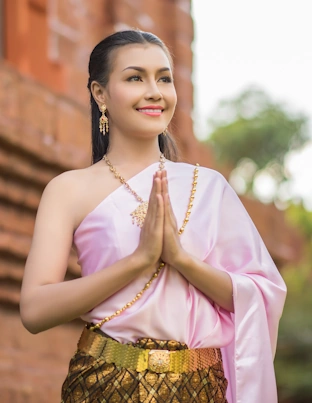
Start with your palms together in front of your chest. The height of your hands and depth of the bow depend on whom you are greeting.
For an everyday ไหว้ (Wai) :
- Place your palms together with your fingers pointing upward.
- Keep your elbows comfortably near your sides.
- Add a small bow when greeting someone; when acknowledging a ไหว้ (Wai) , bringing your palms together can be enough.
Keep your hands together: Bring your palms and fingers together, with your fingers pointing up. Keep the movement comfortable and deliberate. If the hand position feels awkward, ask a colleague to show you.
Three forms taught in formal etiquette
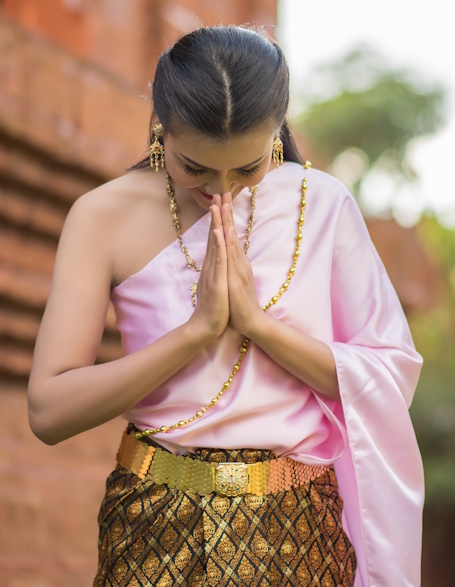
Formal etiquette distinguishes three broad forms according to whom you are greeting. Hand position and the bow work together; in everyday exchanges the movements may be less pronounced.
Level 1: Monks and religious settings
A high ไหว้ (Wai) is used for Buddhist monks and in some religious settings. Your thumbs may come near the space between your eyebrows as you bow.
Level 2: School directors, senior teachers, and elders
For a school director, department head, senior teacher, or elder, raise your hands toward your face and bow. Your thumbs may come near the tip of your nose.
Level 3: People of similar age or standing
For a formal ไหว้ (Wai) to a peer, bring your joined hands toward your face with the thumbs near your chin and bow slightly. Friends may simply wave or greet one another verbally.
When students ไหว้ (Wai) : You can acknowledge the greeting by bringing your palms together without a deep bow. In everyday exchanges, teachers may also smile, nod, or reply aloud. Watch how your school handles individual greetings and the whole-class greeting.
With colleagues, follow the relationship and the occasion. Return a senior colleague’s or elder’s ไหว้ (Wai) respectfully. Among friends or during a brief exchange, a spoken greeting may be enough.
The Thailand Foundation’s guide to the ไหว้ (Wai) illustrates the formal variations and explains how a ไหว้ (Wai) can be acknowledged.
Using a ไหว้ (Wai) when you apologize
A ไหว้ (Wai) can accompany an apology, including a more deliberate bow when you have caused a serious inconvenience. Use a gesture suited to the person and situation. A deeper bow is not necessary for every small mistake.
Say ขอโทษ ค่ะ (Kho thot kha) (female speaker) or ขอโทษครับ (Kho thot khrap) (male speaker). Both can mean “Excuse me” or “I am sorry.” The polite-particle guide explains the female ending used here.
If you arrive late to a meeting, apologize briefly and let the meeting continue. If your mistake has created extra work for a colleague, explain what you will do to put it right. Give that follow-up as much attention as the gesture.
Everyday school situations
Here are a few common situations:
Greeting the school director (ผอ. (Pho o) )
When greeting the school director, use a respectful ไหว้ (Wai) and say:
สวัสดีค่ะ ผอ. (Sawatdi kha pho o)
Arriving in the staffroom
A ไหว้ (Wai) and สวัสดีค่ะ (Sawatdi kha) is a polite way to greet senior colleagues in the morning. With colleagues you know well, follow the tone they use with you. If you are unsure which title to add to a name, see อาจารย์ (Achan) vs ครู (Khru) .
When a ไหว้ (Wai) is not necessary
A nod and polite words are often more practical in these situations:
- When your hands are full: Do not juggle books, a laptop, or a drink. A nod and spoken greeting are fine.
- During a purchase: A spoken ขอบคุณ ค่ะ (Khop khun kha) (“Thank you”) is usually enough. If someone greets you with a ไหว้ (Wai) , acknowledge it; returning the gesture is also fine.
- In passing: If there is no time for a full greeting, a brief nod can be enough.
Ask about ceremonies separately
A morning greeting and a formal ceremony can call for different movements. Before your first ceremony, ask a colleague where to stand and how to greet or receive the people involved. The วันไหว้ครู (Wan wai khru) guide explains what to expect when students pay respect to their teachers.