
Each Thai term is followed by its RTGS romanization. Where a recording is available, select its speaker button to listen.
Your first class
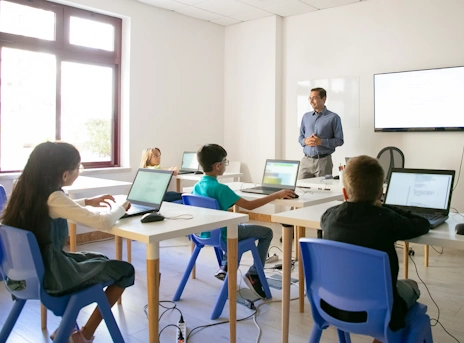
Before your first lesson, check the room, class list, available equipment, and how much English the students have studied. Bring enough materials for the group and have an activity ready that does not depend on equipment you have yet to check.
Routines vary by school and age group. Observing how your Thai colleagues open class, organize activities, and correct students is one of the quickest ways to understand what works in your setting.
Check the room and class size
In many government and private schools, students remain in their homeroom while teachers move between classes. Other schools use subject rooms, so check the timetable and local routine.
You may also encounter the following:
- Class size: Ask for the actual number of students and plan materials accordingly. A crowded class may need activities that work at desks rather than in an open circle.
- Desk layout: Check the aisles and whether furniture can be moved. Plan how students will collect materials without blocking one another.
- Mixed English levels: Students in the same class may have very different levels of confidence and experience. Pair work and optional extension tasks can help.
- Heat and ventilation: Some rooms rely on open windows and ceiling fans rather than air conditioning. Bring water and plan quieter activities for the hottest part of the day.
Shoe etiquette: Some schools ask teachers and students to remove their shoes before entering particular rooms. Clean socks and shoes that are easy to take off can be useful. Follow the signs or ask a colleague if you are unsure.
The class leader and opening routine
Many classes have a student leader, or หัวหน้าห้อง (Hua na hong) . The leader may help distribute materials, pass on messages, and begin the class greeting.
At the start of a lesson, the class leader may wait for your signal and say:
“Students, stand up please!”
The students then stand, ไหว้ (Wai) , and greet the teacher together:
“Good morning, Teacher! How are you today?”
The wording differs from school to school. Greet the class and ask everyone to sit. If you are unsure how to respond to the gesture, see the ไหว้ (Wai) guide’s advice for teachers.
“สนุก (Sanuk) ”: making room for enjoyment
สนุก (Sanuk) means fun or enjoyable. When students use it to describe a lesson, they are telling you they enjoyed it. Ask which part they liked, and consider whether that activity helped them practice the language you intended.
A guessing game can give students a reason to ask questions; quiet writing can give them time to prepare an answer. Use each for a purpose and check what students have learned.
Simple ways to make lessons active
Options to try with a large group include:
- Team tasks: Give desk groups a short problem to solve and a role for each member. If you use points, explain the rules and check that quieter students also get a turn.
- Call and response: Rehearse a short attention signal so the class knows when to stop and listen. Use a separate question or task to check understanding.
- Low-pressure challenges: Give students time to practice with a partner before asking for answers in front of the class.
Use a familiar signal: Practice a clap pattern or countdown when the room is calm, then use it to bring the class back together. ใจเย็น (Chai yen) : Keeping Your Cool explains how to teach the signal and follow up when students need help settling.
Correcting students without embarrassment
Public correction can embarrass students, especially when they are still gaining confidence in English. Calling on a student without warning may cause them to go quiet or smile nervously.
รักษาหน้า (Raksa na) means saving face or preserving someone’s reputation. When correcting an answer, explain what needs changing and give the student time to try again. If the issue is personal or concerns behavior, speak privately when possible.
To give students time to prepare an answer:
- Pair and share first: Give students a short time to compare answers before asking someone to speak.
- Use group responses: Let the whole class repeat a new word before inviting individual volunteers.
- Acknowledge the attempt: A brief “Good try” followed by a helpful prompt keeps the correction focused on learning.
The afternoon slump
Afternoon classes can be difficult when students are tired and the room is hot.
A few small changes can help:
- Start with a short check: Find out what students remember before choosing how much new material to introduce.
- Offer a brief change of activity: A stretch or short movement game may suit younger classes; choose something that fits the age group and available space.
- Use visuals and pair work: Alternate textbook work with pictures, flashcards, or short dialogues.
The closing routine
In many classes, the student leader asks everyone to stand at the end of the lesson. Students may ไหว้ (Wai) and say, “Thank you, Teacher. See you next time.”
Students may also be responsible for sweeping the room, emptying bins, and cleaning the board. Acknowledge the work and leave enough time for the class to follow its routine.
Plan the next lesson from what you observed
After class, note which instructions needed repeating and which tasks students could complete independently. Use those observations to adjust the pace and support in your next lesson.
If you share the class, compare notes with your co-teacher and agree on who will handle each part of the next lesson.